




Lots of access, little use
Copilot or a company GPT has been rolled out, but only a handful of enthusiasts use it. There are no concrete use cases in daily work, no support, and too few leaders going first.
AI ownership for mid-sized companies and scale-ups—as a project, interim, or permanent
I bring AI into your processes so your people actually use it. With leadership I decide where AI pays off, with your teams I rebuild the first process, and after about 90 days a first result is measurable.
Works council and data protection officers are involved from day one.
At Bibel TV: An AI writing assistant for letters, emails, and social media requests. Complex letters in minutes instead of hours. Introduced without a mandate—now used by initially skeptical colleagues too.

Situation
The bottleneck is rarely the model or the tool. What is usually missing is a clear priority, a better process, and someone who brings leadership, business teams, and IT together.
Copilot or a company GPT has been rolled out, but only a handful of enthusiasts use it. There are no concrete use cases in daily work, no support, and too few leaders going first.
Every department tries something different. Nobody decides which process changes first or how its value is measured.
Domain knowledge, exceptions, and handoffs cannot be mapped in off-the-shelf software. The team needs a better process—and a tool that fits it.
Recognize yourself? Then you are not missing technology—you are missing someone who takes ownership of it.
Why now
of German companies with 20+ employees use AI. For the first time, that is more than half.
Bitkom, September 2026 · in my reportof those AI users say they use its potential fully. Six in ten say they do not use it at all.
Bitkom, September 2026 · in my reportArticle 4 of the EU AI Act requires companies that use AI to ensure sufficient AI literacy among their staff.
Regulation (EU) 2024/1689Assess yourself
Usage, processes, ownership, enablement and measurement: you see where you stand and where I would start. No sign-up, nothing is stored.
Start the checkWhy more than half of companies use AI and hardly any get much out of it. From current studies and 187 podcast episodes with practitioners.
Read the summaryExamples
Bibel TV · Viewer services
The assistant drafts replies to letters, emails, and messages in the house voice; a person checks and sends every one. Introduced without a mandate: a trial week, then one-to-one sessions. Skeptics came around after it helped with their hardest case.
Bibel TV · Product development
Almost every change used to depend on an external agency, with no in-house developers. I led by example, coached product managers and owners one to one, and introduced Claude Code, Spec Kit, and clear rules with them. Today much is built in-house.
Ninox · AI in the product
With the CEO and the technical co-founder, I developed an AI onboarding: users describe their work, AI generates the data model, and everything stays editable in the Ninox editor.
The first 90 days
Many AI projects start with a list of use cases. I start with how the work really runs today. The first cycle usually takes about 90 days, depending on approvals in your organisation. Then at least one AI-supported process is running that your people actually use, with a measured result—and the next one follows, with what the team has learned. IT security, legal, data protection, and architecture join as the risk requires, with specialist partners where needed.
Conversations with leadership: what should get better, and where are we today? Outcome: goals, baseline, and measures, in writing.
With the people who run them every day: workflows, handoffs and exceptions, blockers and friction, good and bad moments. Outcome: a clear picture of where it really gets stuck.
Rating by value, feasibility, and risk. Outcome: three initiatives in a fixed order, and a list of what we deliberately will not do. Not every answer needs AI: at ChurchDesk, days of phone tag became a booking capability for every customer, without any AI.
One important process is redesigned with the people involved and built as a working solution. Built so your team can run it themselves a year from now. Plus two quick improvements people notice in daily work right away.
Guidance on real work, AI champions with real time allocated, an AI guideline, AI literacy under Article 4 of the EU AI Act. At the end: a measured result and the next initiative.
Working together
It always starts with a free conversation (30 minutes). Then you decide which form of collaboration fits.
In two weeks you know where AI should start in your company, and where it should not. I talk to leadership and to the people who do the work. Then you decide whether and how to continue.
Also possible: one bounded process we rebuild together.
I take ownership of AI for a defined period, following the 90-day plan. Afterwards I hand over to someone in-house I have onboarded—and can help with the role profile and selection. Or we extend. Or you fill the role permanently, with me if you like.
Want to fill the role permanently from the start? Then let’s talk about a position where strategy, delivery, and capability building stay in one pair of hands.
For leaders and AI owners who do the work themselves and want an experienced sparring partner. One-to-one coaching, fixed office hours for your team, and training on real work instead of in a classroom.
Discuss guidanceAbout

I have led product and design teams, served on a Senior Leadership Team, and designed software for banks and insurers, media companies, and platforms. Today I build AI-supported processes myself: at Bibel TV, development builds directly on my prototype code. That lets me talk priorities with leadership, real work with business teams, and the actual system with IT. Product design taught me to take people seriously: their context, their goals, and what slows them down every day. An AI rollout needs exactly that, inside the company.
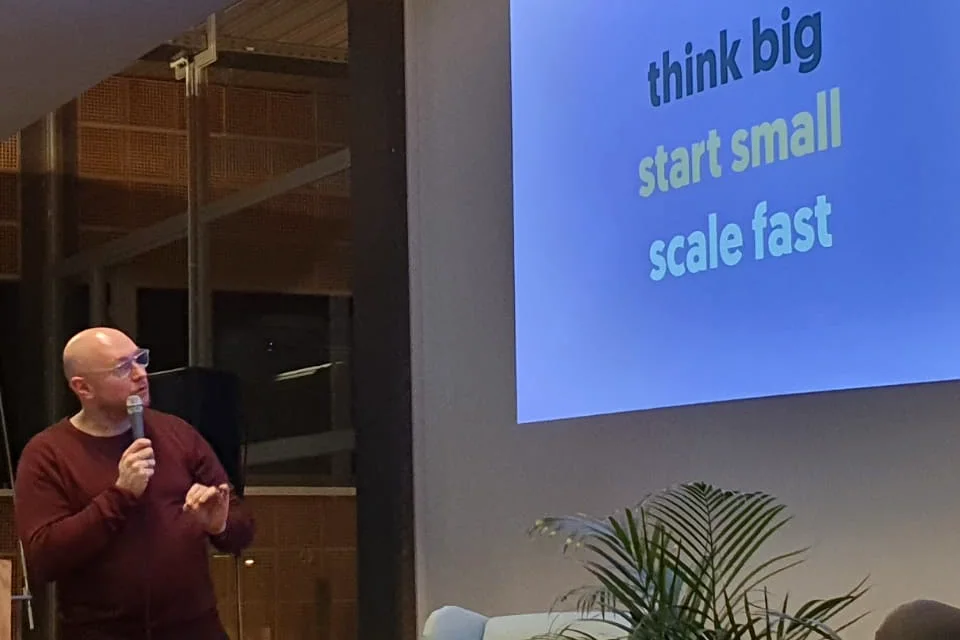
Product and design leadership, Senior Leadership Team, distributed teams in Germany and New York, mentoring.
Product strategy, process design, prototypes in real code, automation with APIs and n8n.
Leadership workshops and one-to-one guidance inside daily work. Ten years mentoring career changers at CareerFoundry, guest lecturer at Spiced Academy, design-thinking training at Hypoport, keynote at ICCM Europe in Brussels. Today, my own programme, AI Design Mentor.
Questions
Because AI rollouts rarely fail on the model—they fail on adoption. Shaping processes that people actually want to use has been my work for more than 15 years. Many AI leads today come from product management, process management, or business functions, not from research.
I build myself, work directly with your teams, and hand over to your people. For specialist topics such as legal, IT security, or complex data architecture, I bring in the right partners.
Early and openly. The works council, data protection, and IT security are involved from the start; a clear AI guideline and firm data rules are among the first outcomes. Where AI prepares texts or decisions, a person always gives the final approval.
Your people bring the domain knowledge; I bring the pattern. Complaints, quotes, or order handling—these are processes full of expertise, exceptions, and handoffs. I have redesigned exactly such processes at a media company, on software platforms, and in a listed financial group.
It depends on the format. The intro call is free. After it, you receive a concrete proposal with scope, outcome, and price.
Both are possible. A good path is often to start with an interim mandate and decide after 90 days whether and how to fill the role permanently—with me if you like.
Book a 30-minute call directly or write to me. I reply personally within two working days.